HeyGen's New Video Model Costs a Penny a Second. It Also Graded Its Own Homework.
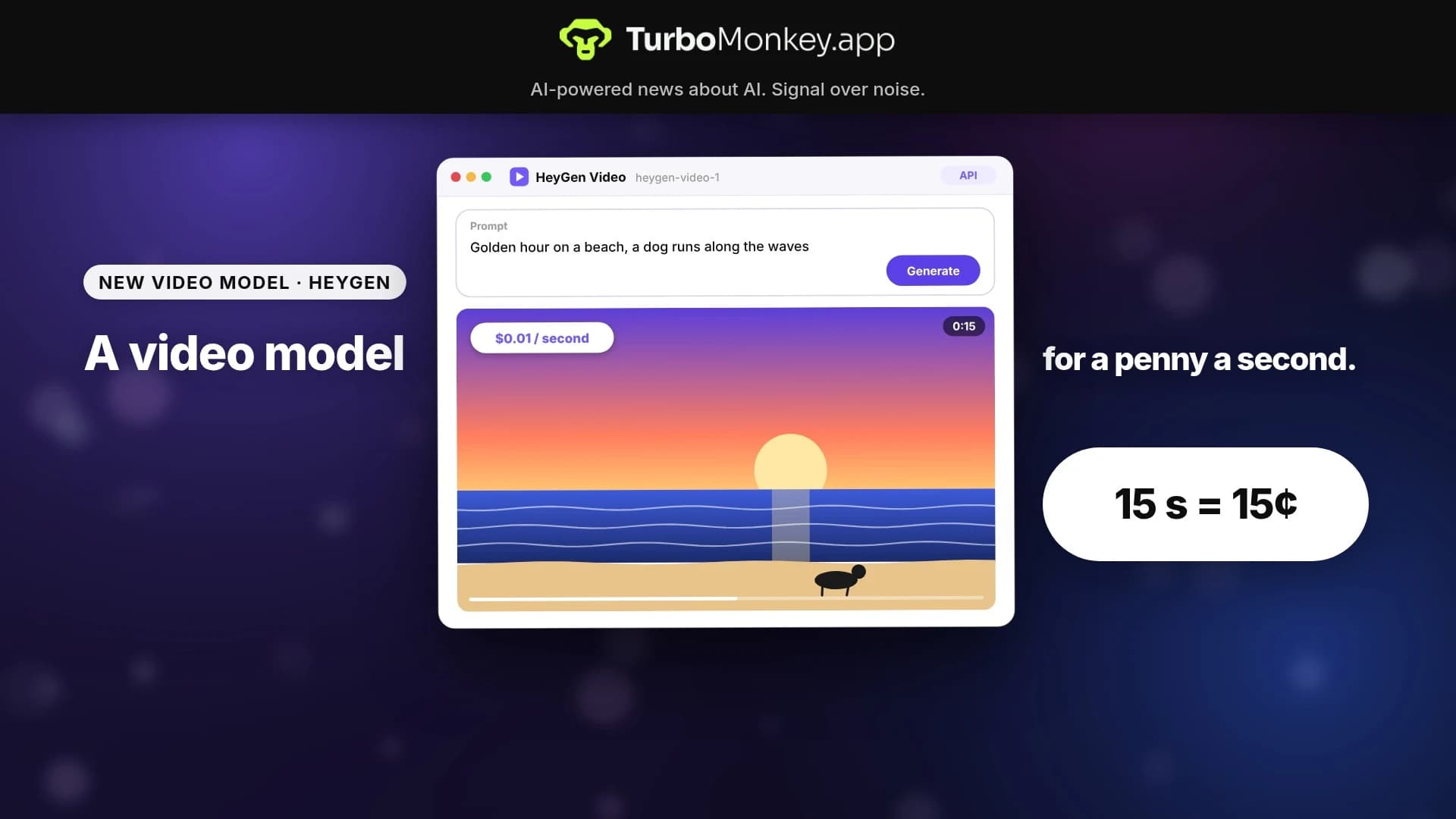
HeyGen Video turns a prompt into a 15-second clip with sound for 15 cents. It's built on MiniMax H3, and its own benchmark chart puts it at exactly 1,000.
Fifteen seconds of video, with sound, for fifteen cents. That's the pitch from HeyGen, the Los Angeles company best known for AI avatars, which launched its first general-purpose video model on September 30.
It's called HeyGen Video. You type a prompt, give it a first frame, or hand it up to 12 reference files (as many as nine images, three videos and three audio clips), and it returns a 5 to 15 second clip. The audio comes in the same call: dialogue, ambience and sound effects. There's no avatar to pick and no lip-sync step. Describe the scene, get the scene.
The price is the headline. Through October, it starts at one cent per second, billed as 50% off a standard two cents. On HeyGen's own chart, Google's Veo 3.1 costs 40 cents a second, Seedance 2.0 about 30 and Kling 3.0 Pro about 17. A full 15-second clip comes in cheaper than a gumball.
Here's the twist: HeyGen didn't build it from scratch. HeyGen Video is MiniMax H3, an open-weights model released in July, post-trained by HeyGen. And HeyGen's chart lists MiniMax's own H3 Max at eight cents a second, so at launch the tuned version sells for an eighth of the price.
Then there are the benchmarks. HeyGen's Elo chart puts HeyGen Video at exactly 1,000, ahead of Seedance 2.0 at 955, H3 Max at 952, Kling 3.0 Pro at 857 and Veo 3.1 at 744. The footnote explains the round number: HeyGen's own score is normalized to 1,000. That's grading your own homework and giving yourself an A-plus. In blind tests against H3 Max, the model it's built on, voters preferred HeyGen Video 55.8% of the time across 650 votes, with a range of 49% to 62%. Somewhere between a coin flip and a win. As of last week, no independent leaderboard had scored it.
To HeyGen's credit, its docs are upfront about the limits. The model struggles with long on-screen text, soft motion like hair or flower petals, and close-up hand work. It does best with short, simple shots: one subject, one place, one action.
Two more catches. The penny price ends with October: HeyGen's launch copy says the standard rate is two cents a second, while its own price chart lists three. And for now it's API only, with no app. About a day and a half after launch, rival Tavus shipped its own model, Griffin.
So who is it for? If you need a pile of short clips for ads, social posts or product shots, a penny a second is hard to beat. Just keep the hands out of frame. Making a Super Bowl ad? You might still want to hire a crew.
Fifteen-second clips for fifteen cents. Hollywood, meet the dollar store. Would you put a penny-a-second clip in your next ad?